November 16, 2026
8 min
How to Plan Your Influencer Marketing Budget in Saudi Arabia?
Written by Soholat SEO
One influencer charges SAR 12,000, while another asks for SAR 3,000. Which offers better value? The answer depends on what each package includes and the results it delivers.
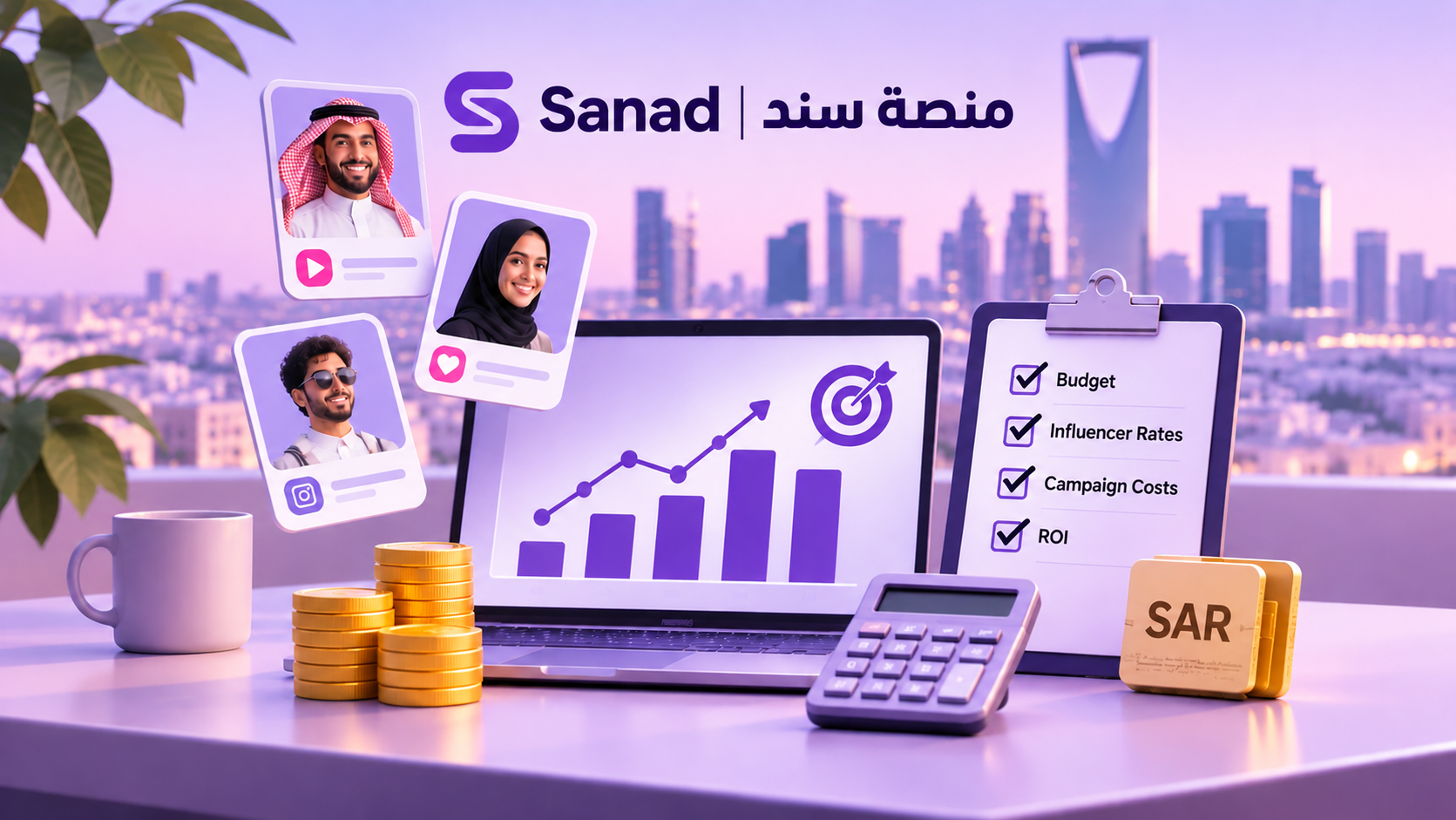
Planning an influencer marketing budget requires understanding your campaign goals, expected costs, and potential returns. In this guide, we explore influencer rates in Saudi Arabia, practical budgeting strategies, and how Sanad platform helps brands manage campaigns and measure performance effectively.
What Is an Influencer Marketing Budget?
An influencer marketing budget is the total amount you set aside for a campaign, from the first agreement to the final results report. It is larger than the influencer’s fee alone.
It covers influencer fees, content production, product samples and shipping, paid promotion of your best-performing content, and a reserve for whatever you did not plan for. Think of a trip: the plane ticket is the biggest line item, but it is not everything you will pay.
When a campaign is budgeted on the influencer’s fee alone, brands often find halfway through that the money is not enough.
How Much Do Influencers Charge in Saudi Arabia?
There is no official price list for influencers in Saudi Arabia, but published estimates for 2026 offer a useful starting point. The table below presents indicative pricing ranges compiled from multiple industry sources, in Saudi riyals (SAR).
Tier | Followers | Approximate price range (SAR) |
|---|---|---|
Nano | Under 10,000 | 500 – 3,000 |
Micro | 10,000 – 100,000 | 2,000 – 15,000 |
Macro | 100,000 – 1 million | 10,000 – 75,000 |
Mega | Over 1 million | 50,000 – 500,000+ |
Estimates differ from one source to another, which is why the ranges are wide. Treat them as a starting point for comparison, not a fixed rate card. A price may cover a single post or a package that includes filming and editing, so do not compare two numbers before you know what each one includes.
Micro-influencers are often a sensible starting point for small and mid-sized stores, because their rates let you test more than one creator and measure how each one performs.
What Factors Affect Influencer Marketing Costs?
Follower count alone does not set the price. These six factors usually drive influencer marketing cost:
Actual views. Ask for the average views on recent posts. The number next to a name is not enough.
Engagement. A smaller account with real engagement can serve you better than a large account with a silent audience.
Platform and content type. A Story usually costs less than a video that needs filming and editing, and some platforms price by the package, such as a Snapchat Story bundle.
Niche and audience. A specialty coffee creator whose audience is in Riyadh is worth more to a coffee bean store than a general creator whose followers are spread across many countries.
Usage rights and exclusivity. Using the content in your own ads, or stopping the creator from promoting your competitors for a set period, raises the price.
Season. Demand climbs during Ramadan, White Friday, and Eid, so prices rise and availability drops.
That is why you should not judge an offer by its price tag. Here is a hypothetical example. One creator asks SAR 4,000 and averages 80,000 views, which works out to SAR 50 per thousand views. Another asks SAR 3,000 and averages 20,000 views, which is SAR 150 per thousand. The second is cheaper on the invoice, but the first is cheaper for reach.
How to Plan Your Influencer Marketing Budget Step by Step
Start from your goal, not from a number you like, and work back to the amount.
Set one goal, in numbers. For example, 150 orders in a month, rather than a general aim such as “increase sales.”
Calculate the most you can afford. Suppose your average order value is SAR 300 and your contribution margin is 40% after variable costs, but before campaign expenses. This leaves SAR 120 per order to cover marketing costs and contribute to profit. If your goal is 150 orders, your break-even campaign budget is 150 × 120 = SAR 18,000, assuming no additional fixed costs are attributable to the campaign.
Choose the right tier for the goal. Use micro-influencers to test a specific audience, and macro-influencers for a wider awareness campaign. Sanad's influencer discovery tools can help you find creators who match your target audience.
Test before you scale. Spread part of the budget across several creators, watch the results for a week or two, then put the rest behind the ones that proved themselves.
Keep a reserve. Set aside a small share for an urgent revision, or to promote content that performs better than expected.
In our example, we choose SAR 15,000, which is below the SAR 18,000 ceiling, to leave a safety margin.
How to Allocate Your Influencer Marketing Budget Effectively
When it comes to influencer marketing budget allocation, no fixed percentage suits everyone. Here is a hypothetical example for a SAR 15,000 budget, for a store that wants direct sales:
Item | Share | Amount (SAR) |
|---|---|---|
Influencer fees (3 micro-influencers, average SAR 2,500 each) | 50% | 7,500 |
Content usage rights and production costs | 10% | 1,500 |
Samples and shipping | 10% | 1,500 |
Paid promotion of the best-performing content | 20% | 3,000 |
Reserve | 10% | 1,500 |
Total | 100% | 15,000 |
Half of the budget goes to creators, and one-fifth goes to content that has proven it sells. These shares change with your goal. If you want to introduce a new brand, raise the creator share to reach a larger audience. If you want sales, raise the share for promoting the content that actually sells.
What Additional Costs Should You Consider?
Influencer marketing cost often runs past the plan because some items were never counted. Review this list before you lock in the amount:
Content usage rights. Using a creator’s video in your paid ads can carry extra fees, which vary by duration and scope.
Exclusivity. Preventing a creator from working with your competitors has a price.
Samples, packaging, and shipping. The product itself is part of the campaign cost, even if you do not pay for it in cash.
Reshoots and revisions. Agree in advance on how many revisions the price includes. Using Sanad's content management tools can help you organize content submissions, approvals, and revision requests.
Management. Agency or platform fees, if you use either.
Value-added tax. VAT of 15% is added if the creator is registered for it.
The discount itself. A code that gives followers a discount comes out of your profit margin, not out of the creator’s fee.
Ask every creator for a written offer that states what the price includes, and compare the total cost, not the price of a single post.
How to Measure Influencer Marketing ROI and ROAS
Influencer marketing ROI does not show up in view counts. It shows up in your store’s numbers. Two metrics matter most:
ROAS (return on ad spend) tells you how many riyals of sales came back for every riyal you spent.
ROI (return on investment) tells you how much you actually earned after subtracting the cost.
Here are the formulas:
ROAS = campaign sales ÷ campaign cost
ROI = (campaign profit − campaign cost) ÷ campaign cost × 100
Suppose you spend SAR 15,000 on a campaign that generates 150 orders at SAR 300 each, totaling SAR 45,000 in sales. Your ROAS is 3, while a 40% contribution margin gives you SAR 18,000 before campaign costs and a 20% ROI after deducting your budget. Your break-even ROAS is 2.5 (1 ÷ 0.40), assuming no additional campaign costs. Below this level, the campaign becomes unprofitable.
To track results, assign each influencer a unique discount code and tracking link, avoiding double-counted orders. For brand awareness campaigns, focus on reach, views, website visits, and branded searches.
You can also use Sanad's campaign performance reports to track results, compare influencer performance, and make better budgeting decisions.
Common Influencer Marketing Budgeting Mistakes to Avoid
Counting only the creator’s fee and ignoring the other items.
Putting the entire budget behind one large influencer.
Picking the cheapest offer without knowing what it includes.
Launching without a code or link to track sales.
Booking creators only days before a season, when prices are rising and availability is falling.
Paying the full amount before agreeing on deliverables and revisions.
Hiring a creator without checking their advertising license, and leaving ad disclosure out of the content.
How Sanad Helps Brands Discover Influencers and Manage Campaigns
From choosing the influencer to reading the results, a campaign takes a great deal of time and effort. That is where Sanad platform comes in. Sanad is an influencer marketing platform that serves brands in Saudi Arabia, and it helps you in the following ways:
Creator discovery. Advanced search tools point you to the creators who fit your brand best.
One place for your campaign. Sanad brings the stages of your campaign together on a single platform.
Content Management. Use Sanad to track influencer content submissions, review and approve content, and request revisions.
Discount codes and partnership links. You can offer them to each creator’s audience.
Data. Real-time data and analytics help you decide whether to increase spending or stop.
Managed Campaigns: Manage your campaigns independently through Sanad, or choose the Managed Campaigns service for an additional fee, allowing the Sanad team to manage your campaign on your behalf.
If you want to build your budget on numbers rather than guesswork, get started and book a consultation with the Sanad team.
Frequently asked questions
Sanad.All rights reserved.
Riyadh - Al Yasmin District - Anas Ibn Malik
To contact sales:info@getsanad.sa
commercial register:1009128803
Tax ID number:311767139100003